Introduction
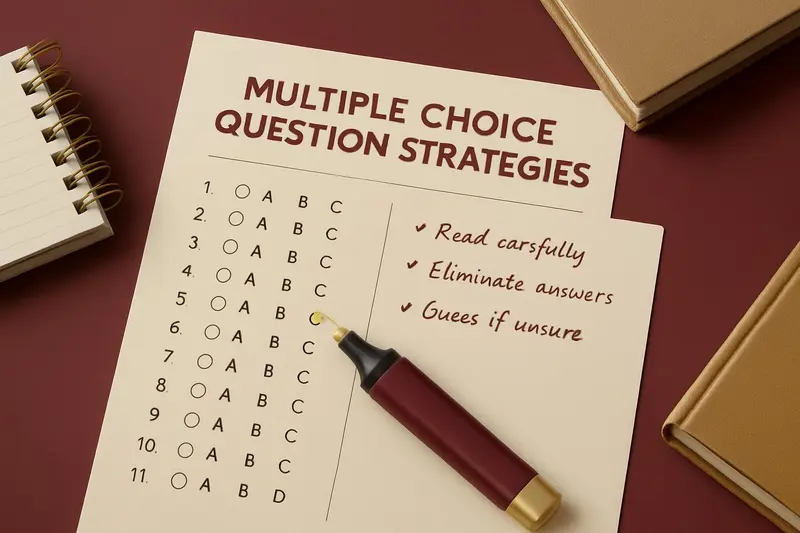
The multiple-choice section accounts for 40% of your AP US History exam score. With 55 questions in 55 minutes, you need both speed and accuracy. This guide provides proven strategies to help you maximize your MCQ score by understanding question types, eliminating wrong answers, and managing your time effectively.
Understanding the MCQ Format
The MCQ section consists of:
- 55 questions covering all historical periods
- 55 minutes total time (approximately 1 minute per question)
- 4 answer choices per question (A, B, C, D)
- 40% of total score
Strategy 1: Read the Question First
Before looking at the answer choices, read the question carefully. This prevents you from being influenced by plausible but incorrect answers. Identify what the question is asking:
- Is it asking for a cause or consequence?
- Is it asking about a specific time period?
- Is it asking for the BEST answer or an exception?
Pro tip: Circle key words in the question like "EXCEPT," "MOST," "LEAST," or "PRIMARILY."
Strategy 2: Use Process of Elimination
Eliminate obviously wrong answers first. This increases your odds of selecting the correct answer:
- Eliminate factually incorrect answers: If an answer contains false information, eliminate it immediately.
- Eliminate answers that don't address the question: Even if true, if it doesn't answer what's being asked, eliminate it.
- Eliminate extreme answers: Words like "always," "never," or "all" are often incorrect.
- Eliminate answers that contradict the question: If the question asks for a positive effect, eliminate negative answers.
Strategy 3: Recognize Common Question Types
Cause and Effect Questions: These ask why something happened or what resulted from an event. Look for logical connections between historical events.
Chronological Questions: These ask about the order of events or what happened during a specific period. Know your timeline.
Interpretation Questions: These ask you to interpret primary sources or analyze historical perspectives. Look for the main idea or perspective.
Comparison Questions: These ask you to compare two historical events or periods. Identify similarities and differences.
Exception Questions: These ask for the EXCEPT or LEAST true answer. Be careful with these—you're looking for the wrong answer.
Strategy 4: Don't Overthink
Your first instinct is often correct. If you've studied well, trust your knowledge. Overthinking can lead to changing correct answers to incorrect ones. If you're genuinely unsure, make an educated guess and move on.
Strategy 5: Manage Your Time
With 55 minutes for 55 questions, you have about 1 minute per question. Follow this approach:
- 0-45 minutes: Answer all 55 questions, spending about 1 minute each
- 45-55 minutes: Review flagged or uncertain questions
If you're stuck on a question after 1-1.5 minutes, mark it and move on. You can return to it later if time permits.
Strategy 6: Know Key Dates and Events
While the MCQ doesn't require you to memorize every date, knowing major dates helps you answer chronological questions. Memorize these key dates:
- 1492 - Columbus reaches Americas
- 1607 - Jamestown founded
- 1776 - Declaration of Independence
- 1787 - Constitutional Convention
- 1861-1865 - Civil War
- 1898 - Spanish-American War
- 1917 - US enters World War I
- 1929 - Stock market crash
- 1941 - US enters World War II
- 1945 - End of World War II
Strategy 7: Recognize Historical Themes
Rather than memorizing isolated facts, understand major historical themes. Questions often test your understanding of themes like:
- American identity and diversity
- Politics and power
- Work, exchange, and technology
- Culture and society
- Migration and settlement
- America in the world
Strategy 8: Use Context Clues
Sometimes you can answer a question even if you're not certain about the specific content. Look for context clues:
- The question stem often provides hints
- Answer choices can reveal what the question is about
- Eliminate answers that don't fit the historical context
Strategy 9: Practice Regularly
The best way to improve your MCQ score is through consistent practice. Use official College Board materials and practice tests. Track your performance to identify weak areas and focus your studying accordingly.
Strategy 10: Stay Calm and Confident
Test anxiety can hurt your performance. Remember:
- You don't need to answer every question perfectly to get a good score
- Educated guesses are better than leaving questions blank
- Trust your preparation and knowledge
- Maintain a positive mindset throughout the exam
Common MCQ Mistakes to Avoid
1. Misreading the Question: Always read carefully, especially for EXCEPT questions.
2. Selecting the First Correct-Looking Answer: Read all four options before choosing.
3. Spending Too Much Time on One Question: Move on if you're stuck; return later if time permits.
4. Changing Correct Answers: Trust your first instinct unless you're certain it's wrong.
5. Leaving Questions Blank: Always guess if you're unsure; you might get it right.
Sample Time Schedule
Here's how to manage your 55 minutes:
- 0:00 - 0:45: Answer all 55 questions (1 minute each)
- 0:45 - 0:55: Review flagged questions and make final decisions
Conclusion
Mastering the MCQ section requires a combination of content knowledge, test-taking strategies, and time management. By using process of elimination, recognizing question types, managing your time effectively, and practicing regularly, you can significantly improve your MCQ score. Remember, the MCQ is worth 40% of your total score, so investing time in this section pays off. Use our APUSH calculator to track your progress and monitor your improvement over time.