Introduction
The Document-Based Question (DBQ) is worth 25% of your AP US History exam score, making it the single most important section. This comprehensive guide will teach you how to master DBQ essays by understanding the prompt, analyzing documents effectively, and constructing a compelling argument. With practice and the right strategies, you can earn a high score on this critical section.
Understanding the DBQ Format
The DBQ section includes:
- 10-minute reading period: Time to read the prompt and documents
- 1 essay prompt: A historical question to answer
- 7-10 documents: Primary and secondary sources to analyze
- 60 minutes total: To write your essay
Step 1: Understand the Prompt
Before looking at documents, read the prompt carefully. The prompt typically asks you to:
- Evaluate a historical claim or perspective
- Analyze causes or consequences of an event
- Compare different historical perspectives
- Assess the validity of a historical argument
Pro tip: Circle key words in the prompt. Words like "evaluate," "analyze," "compare," and "assess" indicate what type of thinking is required.
Step 2: Analyze the Documents
For each document, identify:
- Source: Who created it and when?
- Purpose: Why was it created?
- Perspective: What viewpoint does it represent?
- Main idea: What is the document's key message?
- Relevance: How does it relate to the prompt?
Don't just summarize documents. Analyze what they reveal about the historical period and how they support or challenge different interpretations.
Step 3: Develop Your Thesis
Your thesis should:
- Directly answer the prompt
- Be arguable and specific
- Indicate your main argument
- Preview your supporting evidence
Example thesis: "While some historians argue that the Industrial Revolution primarily benefited American society through technological advancement, the documents reveal that it simultaneously created significant social problems including labor exploitation and urban overcrowding that disproportionately affected working-class Americans."
Step 4: Structure Your Essay
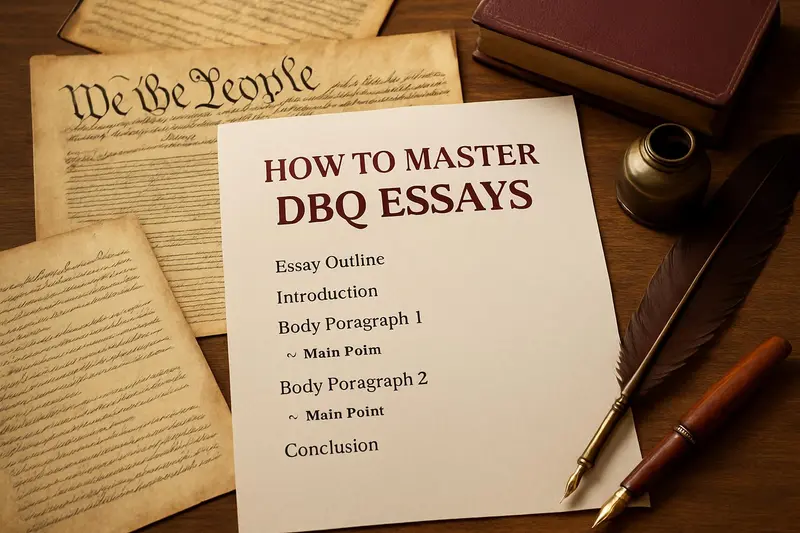
A strong DBQ essay follows this structure:
Introduction (1 paragraph):
- Hook or context
- Clear thesis statement
Body Paragraphs (4-5 paragraphs):
- Topic sentence with clear argument
- Analysis of 1-2 documents
- Historical context and evidence
- Connection back to thesis
Conclusion (1 paragraph):
- Restate thesis in new words
- Summarize main arguments
- Broader historical significance
Step 5: Integrate Documents Effectively
Do:
- Quote directly from documents
- Cite documents by number (Document 3)
- Analyze what the quote reveals
- Use documents to support your argument
- Reference at least 6 of 7-10 documents
Don't:
- Simply summarize documents
- Use documents without analysis
- Ignore the source information
- Rely on only 2-3 documents
- Contradict the documents with your argument
Step 6: Provide Historical Context
Beyond the documents, demonstrate knowledge of the broader historical period. Include:
- Key events and dates
- Important figures and their roles
- Broader historical trends
- Relevant historical movements
This shows the graders that you understand the historical context, not just what the documents say.
Step 7: Address Complexity
To earn top scores, address complexity by:
- Acknowledging multiple perspectives
- Recognizing nuance and contradictions
- Explaining why different interpretations exist
- Showing how context affects interpretation
DBQ Scoring Rubric Overview
The DBQ is scored on a 7-point scale:
- Thesis (0-1 points): Clear, specific, and answers the prompt
- Document Evidence (0-3 points): Uses documents to support argument
- Outside Evidence (0-1 point): Includes relevant historical knowledge
- Complexity (0-1 point): Addresses nuance and multiple perspectives
- Synthesis (0-1 point): Makes connections across time periods or disciplines
Common DBQ Mistakes to Avoid
1. Weak Thesis: Your thesis must directly answer the prompt, not just introduce the topic.
2. Document Summarization: Don't just summarize what documents say. Analyze what they reveal about the historical period.
3. Ignoring Source Information: The source (author, date, purpose) provides important context for analysis.
4. Using Too Few Documents: Reference at least 6 of the 7-10 provided documents.
5. Lack of Outside Knowledge: Include relevant historical context beyond what's in the documents.
Practice Strategy
To master DBQ essays:
- Practice with official College Board DBQs
- Write full essays under timed conditions (60 minutes)
- Have teachers or peers review your essays
- Study high-scoring sample essays
- Focus on weaknesses identified in feedback
Conclusion
Mastering the DBQ requires understanding the format, analyzing documents effectively, developing strong arguments, and integrating evidence skillfully. With consistent practice and attention to the scoring rubric, you can significantly improve your DBQ score. Remember, the DBQ is worth 25% of your total exam score, so the effort you invest in mastering this section will pay off. Use our APUSH calculator to track your overall progress as you prepare for the exam.