Introduction
Essays account for 40% of your AP US History exam score. Whether you're writing a DBQ, LEQ, or SAQ, strong essay writing skills are essential. This guide teaches you the fundamental techniques used by high-scoring students: developing compelling thesis statements, integrating evidence effectively, and crafting persuasive conclusions.
The Foundation: Understanding Essay Structure
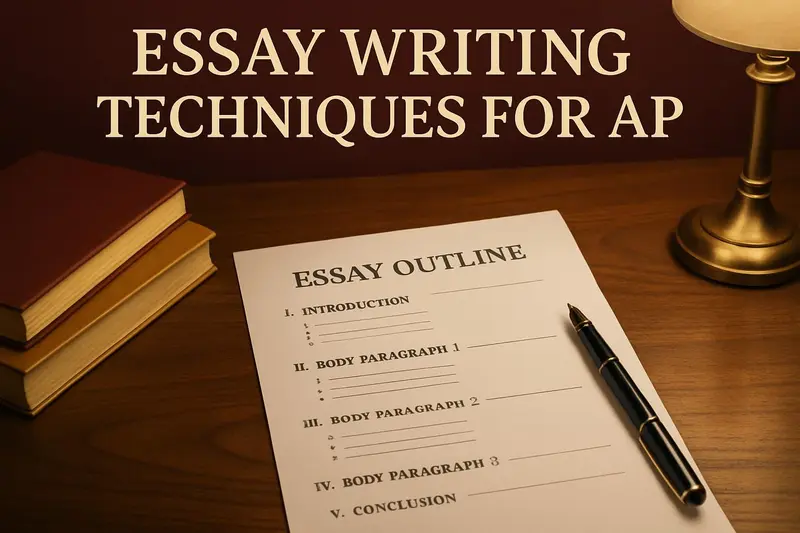
Every strong essay follows this basic structure:
- Introduction: Hook, context, and thesis
- Body Paragraphs: Topic sentence, evidence, analysis, and connection to thesis
- Conclusion: Restatement of thesis, summary, and broader significance
Technique 1: Craft a Powerful Thesis Statement
Your thesis is the heart of your essay. It should:
- Be specific: Avoid vague generalizations
- Be arguable: Present a position that can be debated
- Answer the prompt directly: Address what's being asked
- Preview your argument: Hint at your supporting points
Weak thesis: "The Civil War was an important event in American history."
Strong thesis: "While the Civil War's primary purpose was to preserve the Union, its most significant consequence was the transformation of American society through the abolition of slavery and the subsequent struggle for African American rights."
Technique 2: Use Specific Historical Evidence
Never make claims without supporting them with specific evidence. Use:
- Specific dates: Not "in the 1800s" but "in 1865"
- Named individuals: Not "a president" but "Lincoln"
- Specific events: Not "a major battle" but "the Battle of Gettysburg"
- Quotations: Direct quotes from documents or sources
- Statistics: Specific numbers and data
Technique 3: Analyze, Don't Just Summarize
The difference between a good essay and a great essay is analysis. Don't just state facts; explain what they mean and why they matter.
Summarizing: "The Emancipation Proclamation freed slaves in Confederate states."
Analyzing: "The Emancipation Proclamation, issued in 1863, transformed the Civil War from a battle for Union preservation into a war for human freedom, thereby shifting the moral foundation of the conflict and preventing European intervention on behalf of the Confederacy."
Technique 4: Integrate Evidence Seamlessly
When using quotes or evidence, integrate them smoothly into your sentences:
Awkward: "Lincoln said 'Four score and seven years ago.' This was important."
Smooth: "In his Gettysburg Address, Lincoln invoked the nation's founding by stating, 'Four score and seven years ago our fathers brought forth on this continent a new nation,' thereby reframing the Civil War as a test of democratic principles."
Technique 5: Develop Strong Topic Sentences
Each body paragraph should begin with a clear topic sentence that:
- Connects to your thesis
- Introduces the paragraph's main idea
- Is specific and arguable
Weak topic sentence: "The Progressive Era had many reforms."
Strong topic sentence: "Progressive Era reforms fundamentally altered the relationship between government and business by establishing regulatory agencies that challenged laissez-faire capitalism."
Technique 6: Show Connections and Causation
Use transitional phrases to show how ideas connect:
- "As a result of..."
- "Consequently..."
- "This led to..."
- "In response to..."
- "Because of..."
- "Therefore..."
Technique 7: Address Complexity and Nuance
High-scoring essays acknowledge complexity:
- Recognize multiple perspectives
- Acknowledge contradictions
- Explain why interpretations differ
- Show how context affects meaning
Example: "While some historians emphasize the economic benefits of westward expansion, others highlight the devastating consequences for Native American populations, suggesting that the significance of this movement depends on whose perspective we prioritize."
Technique 8: Write a Compelling Conclusion
Your conclusion should:
- Restate your thesis in new words (not just copy it)
- Summarize your main arguments
- Discuss broader historical significance
- Avoid introducing new evidence
Weak conclusion: "In conclusion, the Civil War was very important and changed America."
Strong conclusion: "The Civil War ultimately transformed America from a nation of competing regional interests into a unified country committed to the principle that all people are created equal. This fundamental shift in national identity established the foundation for subsequent civil rights movements and redefined American democracy for generations to come."
Technique 9: Use Varied Sentence Structure
Vary your sentence length and structure to maintain reader interest:
- Mix short, punchy sentences with longer, complex ones
- Use different sentence starters
- Avoid repetitive patterns
Technique 10: Edit and Proofread
Always leave time to review your essay:
- Check for spelling and grammar errors
- Ensure clarity and logical flow
- Verify that evidence supports your claims
- Confirm your thesis is clearly stated
Common Essay Writing Mistakes
1. Vague thesis: Your thesis must be specific and arguable.
2. Unsupported claims: Every major claim needs evidence.
3. Summarizing instead of analyzing: Explain the significance of your evidence.
4. Weak conclusions: Don't just repeat your introduction.
5. Poor organization: Ensure logical flow between paragraphs.
Practice Strategy
To master essay writing:
- Write essays regularly under timed conditions
- Have teachers or peers provide feedback
- Study high-scoring sample essays
- Focus on developing strong thesis statements
- Practice integrating evidence smoothly
Conclusion
Strong essay writing is a skill that improves with practice. By mastering thesis development, evidence integration, and analysis techniques, you'll significantly improve your essay scores. Remember, essays account for 40% of your AP US History exam, so the time you invest in improving your writing will pay off. Use our APUSH calculator to track your overall progress as you prepare for the exam.